Typical settling window
Most cemeteries ask families to wait somewhere between six and twelve months after a burial before a memorial is set. Clay soils, sloping sections and winter burials can push that further out.
Most cemeteries ask families to wait somewhere between six and twelve months after a burial before a memorial is set. Clay soils, sloping sections and winter burials can push that further out.
Soil that has been dug out and returned holds more air and less structure than undisturbed ground. It compacts under rain and gravity, and it almost never compacts at the same rate across the whole grave.
The concrete base under a memorial is usually a cemetery charge, not part of the monument dealer's price. Confirm which party is pouring it before you compare two estimates side by side.
A concrete beam that spans the grave and bears on firm ground either side carries no load on the backfill. Cemeteries using this method sometimes allow a stone to be set much sooner.
The wait between a burial and the day a stone goes up catches most families off guard, because nobody mentions it at the funeral home and the monument dealer often does not raise it until the order is being written. Six months is common. A year is not unusual. In heavy clay or on a slope, a cemetery may hold the line longer still, and the reason has nothing to do with staffing or paperwork backlogs. It is about what the soil under the grave is doing, quietly, for months after everyone has gone home.
Excavated earth never goes back the way it came. Digging breaks up the structure of the soil, air gets into it, and when it is returned to the grave it occupies more volume than the undisturbed ground around it. Rain and gravity then do the compacting, slowly, over a full cycle of wet and dry weather. The surface drops. It rarely drops evenly, which is the part that matters, because a memorial set on soil that sinks a half inch more on one side than the other will lean, and a leaning stone is a stone that eventually goes over.
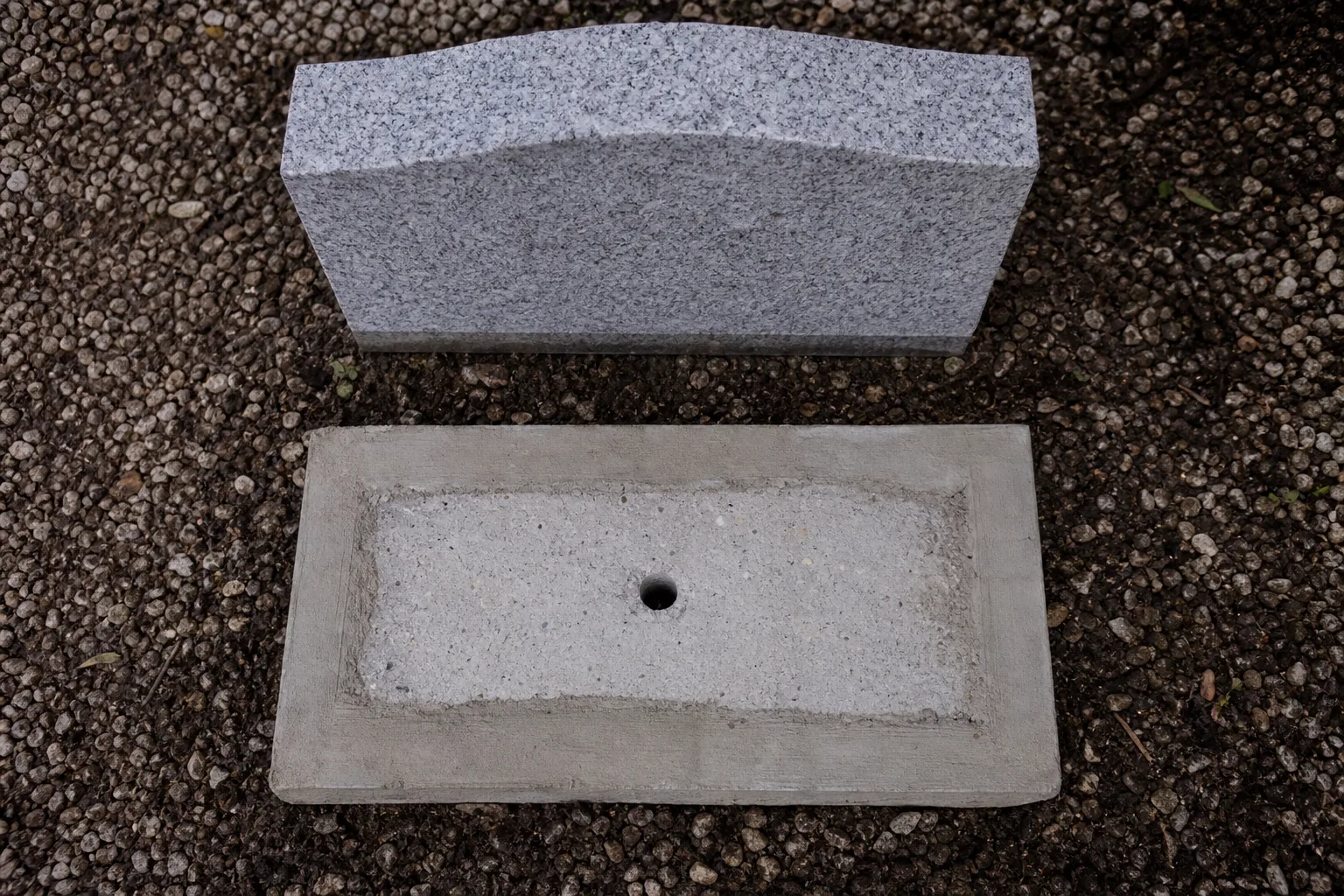
The base a stone sits on is usually poured or set by the cemetery, not by the monument dealer, and it is billed separately. What gets built varies: a poured concrete slab set below the frost line, a precast base, or a concrete beam bridging the grave and bearing on the firm, undisturbed ground on either side of the excavation. That last approach, sometimes called a ground anchor system, is the one that sidesteps settlement entirely, because the memorial's weight never rests on the backfill at all. Ask which method the cemetery uses before you assume the wait applies to your plot.
Above the foundation, the stone is fixed with stainless steel dowels, typically two, epoxied into drilled holes in both the base and the die, which is the upright part carrying the inscription. The bed joint gets a non-staining mortar or a proprietary adhesive. A careful reader asks what diameter the dowels are, whether they are stainless or galvanized, and how deep they go, because a short dowel in a shallow hole will pass its first inspection and fail its fourth. The Occupational Safety and Health Administration oversees the working conditions of the crews doing this lifting, which is one reason a setting crew of two shows up rather than one man with a hand truck.
Most cemeteries run periodic checks across sections of the grounds, and the test is deliberately unsophisticated: a person leans on the stone with a measured, steady push and watches for movement at the joint. Some use a calibrated pressure device. A memorial that rocks, or that has opened a visible gap at the bed joint, gets tagged, and the plot holder of record is notified at the last address the office has. If nobody responds, the usual next step is that the stone is laid flat on the grave, face up, until it can be reset. It is not damage. It is the cemetery removing a tipping hazard while preserving the memorial.
Monument dealers commonly warrant their setting work for a defined period, often several years, against failure of the fixing rather than against ground movement or vandalism. Read that clause before you sign, and keep the invoice, because a reset ten years out is a chargeable visit and the estimate will reflect the equipment needed. Where the cemetery poured the foundation and the foundation is what moved, responsibility may sit with the cemetery, so establish in writing who built what. The Federal Trade Commission is responsible for rules governing how funeral goods and services are priced and disclosed, and a written, itemized quote is the document that settles most of these questions later.
Keep three pieces of paper together somewhere a relative can find them: the deed or certificate of interment rights, the cemetery's permit for the memorial, and the dealer's setting invoice with the warranty terms on it. That folder is what turns a tagged stone into a phone call and a scheduled reset, rather than a season of finding out who is supposed to do what.